Saturday, February 23, 2013

Hue


We have now had a chance to explore some of the high points of Hue, the second ‘H’ on our tour of Vietnam. During the Vietnam War (or the American War, depending on your perspective) Hue was often in the news, as was Da Nang which had an airbase nearby. As most of the places on our tour seem to be UNESCO World Heritage sites we aren’t focusing on the war, but instead on a massive citadel which was commenced in 1802 when the Emperor decided to move the capital city from Hanoi to Hue.

The citadel was established by the first Nguyen emperor and contains an Imperial city, which in turn contains the Purple Forbidden City. It was used until the last emperor died in the mid 1900s. Originally it contained magnificently decorated rooms and apartments for the Emperor, his wives and concubines and his eunuchs who performed administrative functions. As it was constructed of wood it has suffered significant damage, but much more was inflicted during the war. Parts have undergone restoration. We walked more than 3 km through a number of different areas of the Citadel, only touching the surface really.
The main entrance to the Citadel which is surrounded by a moat

Inside the Citadel, leading towards the Imperial City

Our guide, Ut, with an imperial dragon statue with a pearl in tis mouth

One of the restored covered walkways in the accommodation area of the Citadel

After the Citadel we visited Tien Mu Pagoda which overlooks the Perfume River, one of Vietnam’s major rivers. The pagoda is in the grounds of an active monastery, and when we visited we were able to hear and watch the community of monks chanting their prayers.  The community gained international when one of the monks burnt himself to death in 1963 in protest against the government’s violation of religious rights. The car he drove to his death is preserved at the monastery.
Tien Mu Pagoda and frangipani trees

Monks at prayer

The car driven by the monk who self-immolated in 1963

  Our return to Hue for the night was via a privately owned “dragon boat”. All through our journey the owners plied their captive audience with their wares – trousers, pyjamas, bookmarks and many other goods were brought out for us to hopefully purchase. The term “sitting ducks” sprang to mind.
A row of dragon boat prows

On the dragon boat - merchandise spread for sale. The boat is actually the family home.

In fact the locals seem to be very good at employing this tactic – cafes, cruise boats are fair game, and when you leave the bus at your hotel you often have to run the gauntlet and avoid eye contact. Our guide introduced us to the concept of the 3 generation T shirt. You buy it and after the first wash it fits your child, after the second wash it fits your grandchild. I haven’t bought any T shirts yet.

The following morning we visited the tomb of the Emperor Tu Duc which was built over 3 years from 1864 -7. It is an extensive parkland equipped as a palace might be with all the buildings and accommodation that might be required. He died without an heir because he contracted smallpox and wrote his own epitaph which is on a giant stele weighing 20 tonnes. This emperor had a poetic bent, but that didn’t stop the cruelty involved in the killing of the 300 workers who constructed his actual burial place which hasn’t been found.
The stele containing the Emperor Tu Duc's epitaph

Replica of the Emperor's throne

At the end of this tour we had a bit of fun dressing up a queens and kings and having our photos taken. Then we headed off to our 3rd H destination, Hoi An.
Emperor David and his Queen Joy

Emperor David in his palanquin with bearers Joy and Marion

The area near Tu Duc's tomb is populated with incense makers. The whole street is full of colourful displays of drying incense just like this one.

Hanoi


20 February

On our return from Ha Long Bay we had a full day of sightseeing in Hanoi, and managed to pack quite a lot in. The tour must go on despite the fact that it was raining – actually the first rain we have had. Hanoi has 7 million people and 4 million motorbikes. The only road rule in Hanoi is that there are no road rules. Crossing the road can be dangerous, especially as they drive on the opposite side of the road, mainly, and traffic lights are for ignoring if there happens to be a break in the traffic. David and I have both been nearly skittled at least once. Our guide says the best way to cross is to move slowly and don’t change direction sharply. The bikes will go around you if they can predict your actions. One of our group posted an excellent snippet on Facebook: Confucius say you haven’t lived until you have braved the traffic in Hanoi.
A street vendor negotiates her way with ease through the Hanoi traffic 

A not unusual sight in Indo China. I am still constantly amazed at what can be carried on a motorbike.

After negotiating traffic and street vendors we spent the morning at the Ethnology Museum followed by the Temple of Knowledge, a centre to honour Confucius and his teachings and other notable teachers from the past. There are stone plaques listing the names of several ancient PhD recipients, and temples at which the devout pray among the tourists. The gardens are beautiful with lots of very old bonsai and many intricate examples of topiary.
Confucius venerated at the Temple of Literature

Pagodas at the Temple of Literature

A very old and gnarled bonsai at the Temple of Literature

The Ethnology Museum has some excellent outdoor displays of traditional houses and other buildings from a variety of ethnic groups around the country. Vietnam has 54 minority ethnic groups.
The Nha Rong ethnic group of central Vietnam. The tall house is for single men

The long house is for women and couples. Notice the well polished protuberances on the right hand steps for men to use.

The next venue was a soup restaurant for lunch – Pho 24, where we all had enormous bowls of soup with our own choice of herbs and sauces to tailor the flavours to our palate.

After lunch we had a quick tour around the old French quarter, a very congested area selling all kinds of things. Most of the trip was on foot but it was a bit challenging negotiating our way among the bikes parked on the footpath and the street vendors on uneven footpaths in the rain. Our guide managed to secure spaces for all of us on electric carts seating about 10 people, so we zoomed about in relative comfort, watching the driver push her way through  on our behalf.
Produce displayed on the footpath next to the owner's motorbike

We watched while the shopowner peeled a pineapple in a spiral removing all traces of the skin. It only took a few minutes. Pineapples are often sold that way.

Footpath florist shop. Vietnamese are very fond of flowers and at the moment lots of buildings have large pots of chrysanthemums in bloom at the doorway.

Our electric shuttlebus

Next stop was a Taoist temple on an island in the centre of a lake in Central Hanoi. The temple was full of people and incense and donations of money everywhere. Rather than Buddhas there were animals and flowers and even a statue of a horse. The bridge across to the temple was decorated with the distinctive royal style flags. There a a legend associated with the lake – something to do with turtles I think, but Vietnam is full of legends mainly associated with kings and princesses and dragons and many other animals. The legends section of my brain contains a hotchpotch of ingredients but no decent recipe to use them.
The gateway to the temple on the island

The bridge to ther island. Fortunately all the other tourists had just cleared the bridge and I was able to get a clear shot.
 

Inside the Taoist temple. Flowers, cumquat trees and statues of birds. The ying and yang symbols are over the front door of the temple.
 Our final stop for the day was the Ho Chi Minh complex which is set in beautiful gardens and contains his mausoleum, the Presidential Palace – a magnificent yellow building, the house he resided in- Number 54, and another house on stilts which he liked to work from. According to our guide and other literature about him, he liked to live very simply and was, and still is, beloved by the people of Vietnam. The queue to visit his tomb has very long queues on the days it is open to the public.
Ho Chi Minh's Mausoleum.

The his was used by the French administration prior to independence in 1945.


House 54 where Ho Chi Minh lived when he was leader of the country

To end our time in Hanoi we had dinner at a very classy restaurant called Wild Rice. Getting there was a bit of an event. The women went by taxi, following a different route to the one we expected to go, so we were naturally concerned. The men decided to walk in the dark, in the rain, with no map and no phone and we thought they may never arrive. We were very surprised to see them as the door plaque wasn’t easy to see. A group of 4 others went to an Italian restaurant and spent 3.75 million Dong (about $A125) Wine is very expensive in Vietnam so we have been mainly drinking beer or fruit juice. I think I’ve had less than 5 alcoholic drinks in the whole trip. Should be a cheap drunk by the time I get home.
Dinner at Wild Rice. They even changed my meal for me when I inadvertently ordered fresh spring rolls instead instead of cooked ones.
 

Friday, February 22, 2013

Ha Long Bay


18-19 February

After an overnight stop in Hanoi our group set off by coach to Ha Long Bay, about 4 hours’ drive east of Hanoi. It was our first glimpse of Hanoi and unfortunately the weather was cool and drizzly. It had stopped raining by the time we reached Ha Long. The outskirts of Hanoi are a mix of urban and rural areas. The urban areas are quite well developed with most houses made of concrete. The houses are 3-4 storeys high and very skinny. As homeowners are taxed according to the building’s footprint, houses have very narrow frontages. Also, as they expect to be built against, making a row of houses, the owners only paint the front, reasoning that the sides may not be seen. It looks a bit odd.

In between the built up areas is farmland, in our case rice paddies, just being planted. The land is farmed using traditional labour intensive methods.
Ploughing thr rice using buffalo and old style plough

Separating bundles of rice seedling to transplant into the paddy fields

Market gardening. Watering using 2 watering cans suspended from a shoulder yoke

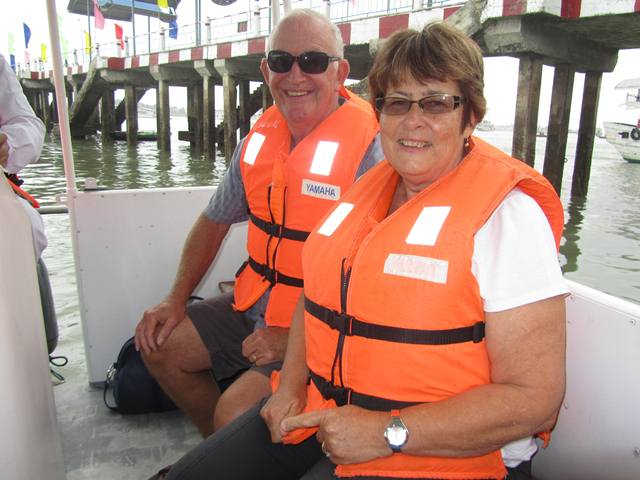
Arriving at Ha Long Bay as passengers for one of over 600 vessels, we kitted up in our safety vests for the transfer by tender to our boat. Once settled we started on the first of 3 banquets we consumed in the 24 hours we were on board. The courses were mostly seafood presented in a variety of ways. The Vietnamese have a very slender build and must be puzzled at the amount of food consumed by westerners on these cruises. For our part we struggled through most of it feeling like absolute gluttons. We definitely did not need or want all the food served.
All kitted up for our transfer to the boat

The super 7 all ready for our first gourmet banquet

Weather conditions at Ha Long Bay were hazy and overcast making good photos impossible to achieve. It would be truly beautiful in clear conditions. However we all admired the views and waited to be told what to do next.
One of many unusual rock formarions and very still water conditions

The next event was a trip through a massive cave (along with hundreds of others). The cave was the largest I have encountered  with many large cavern  joining together and producing stunning formations
A curtain stalactite formation

View of the Bay from the highest viewpoint in the cave

Many resident monkeys hang about hoping for food


Six of our group hired kayaks during the afternoon while the rest sat on a nearby beach. The kayakers showed varying levels of expertise – from novice to expert – but they all had fun.
Marion ready to set off in the kayak
A view of the bay from the beach
 

The following morning we set of for a trip through a different cave. This time I was locked in the toilet in the cabin by David – by accident, I’m assured – but fortunately our guide Ut is diligent about checking numbers, and I was released from captivity.

After an early lunch we returned to Hanoi via a government owned store and purchased a picture which is hand coloured using silk thread. It’s very fine beautiful work carried out by people who have a disability stemming from the effects of the Vietnam War, or as the Vietnamese say, the American War. We were able to photograph the woman who created our artwork.
The woman who created our artwork. The piece she is working on has exquisite tones in black and white