Thursday, February 7, 2013

Phnom Phen - The Killing Fields and a Tuk Tuk Ride


Monday 4 February

This morning we had an optional tour of the Genocide museum followed by a visit to the Killing Fields memorial. The Genocide Museum is devoted to explaining the practices of the Khmer Rouge during the period 1975 – 1979, and also to the memory of many of those killed. The museum is now a UNESCO site and is housed in a former high school which was a major camp used by Pol Pot’s regime to torture and kill many thousands of Cambodians. Standard treatment for all prisoners was to be chained by the ankles to a central metal rod while also being blindfolded. Torture was common to force people to inform, but those who did comply with the regime were murdered anyway.Phnom Penh became a virtual ghost town as its residents suffered forcible removal to the countryside, except for those with higher levels of education who were murdered. Those in power could quickly turn into victims depending on the whim of Pol Pot’s henchmen.
Primitive holding cells


One of the cell blocks complete with barbed wire
The Killing Fields Memorial recognises the mass murders which were perpetrated in over 200 locations throughout Cambodia. It is a sombre place with a magnificent memorial dominating the landscape. Like many families our guide lost 4 of the 10 people in his family to killing field atrocities. However the risk in modern Cambodia is that so few people remain in the older generation that those born after 1979 have difficulty believing the atrocities, and have little understanding of the events. Also, it has proven impossible for international courts to bring perpetrators to justice, and many still hold positions of power and influence in the current Cambodian government.

The journey from central Phnom Penh to the Memorial on the outskirts typified the contrasts in wealth and lifestyle evident in modern Cambodia. Many city dwellers are working in the city to support the old and the very young living in rural communities around the nation. Although there is obvious wealth shown in mansion style houses and expensive cars, the disparity between rich and poor is enormous, and by international standards Cambodia is a very poor country.

The afternoon provided more entertainment for our group of seven. Tony organised 2 tuk tuks to take us to have lunch, and then give us a bit of a tour around the city, trying to avoid road blocks where possible. This proved to be exciting, illuminating and quite a bit of fun. The sights, sounds and smells of city life surrounded us, and we now understand why so many wear surgical masks. The skill of the drivers in manoeuvring their tuk tuks into the smallest of spaces, without any fear of much larger vehicles was astounding. Our driver also took us into one of the large pagodas decorated extensively with gold – quite a beautifully proportioned building. We were also able to visit one of the temples complete with a statue of a large reclining Buddha. It was a very satisfying way to conclude our time in Phnom Penh before being transferred to Siem Reap.
 
Pagoda in Phnom Penh

Inside Buddhist temple, Phnom Penh

Di, Jim, Jenny and Tony in their tuk tuk
 

Tuesday, February 5, 2013

Changi airport and Phnom Penh


Saturday 2-Sunday 3 February

Today our group of seven – David and Joy, Tony and Jenny Georgeson, Di and Jim Ginis, and David’s sister Marion Davis embarked on our next travel adventure

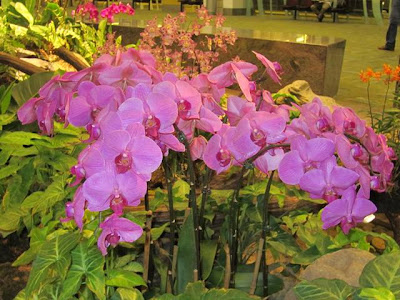
We departed Sydney on 2 February flying with Singapore Airlines and spent overnight transiting at Changi Airport using the Skytrain (a light rail system) to transfer between terminals. An early flight the following morning saw us wandering Terminal 2 and exploring the delights of Changi Airport which included water gardens with goldfish,  other decorative fish features and an area called Sanctuary @Terminal 2. This had a number of reclining lounges, an internet room, a smoking room and beautiful gardens decorated with Singapore orchids.


After our connection to Phnom Penh we soon became aware of the different levels of development and sophistication between it and Singapore. Phnom Penh is a city in transition with large numbers of new buildings, most adorned with the traditional pagoda style roof decoration and several western style condominiums. It also has many old buildings which aren’t in good repair, often being quite run down. The electrical wiring has to be seen to be believed – black spaghetti  is a close but inadequate description.

The traffic is an interesting mix of old and new. There are cycle drawn Tuk-tuks but these are relatively few as most are drawn by motor bikes or motor scooters. Motor scooters abound on all the streets. The drivers usually wear helmets, but passengers don’t. We saw many passengers riding side-saddle including one lady nursing a very young baby. An enormous variety of items are carried on bikes. There are also an increasing number of cars on the streets, mostly Japanese brands, and often at the luxury end of the market. We saw many 4WDs and quite a few Lexus.  The traffic seems to move quite sedately and if you can find a small break crossing the road isn’t difficult. The bikes just deviate around you.

We spent an hour at the Russian Market, a covered market where almost every conceivable item can be purchased. It seems to be arranged in areas – clothing, fabrics, watches and jewellery, dressmaking, bicycle parts, embroidered goods and DVDs but not very much electronics. In among these tightly packed stalls is the food area. Fish, prawns, skinned frogs, mussels, and pork are all displayed and for sale without refrigeration. The strong fish smell accompanied by the occasional rotten vegetable odour, intermingled with the smell of grease from used motorbike parts, all closely packed under a metal roof in temperatures over 30⁰C was almost enough to turn my stomach.  We escaped outside and found a cafĂ© to have a beer around 11am.

We had  lunch at a nice restaurant overlooking the Tonle Sap River. I had Cambodian Fish Amok, while David had steamed fish with ginger, Both meals were very tasty. A Cambodian dancer and her partner with a type of xylophone entertained all the diners. This restaurant is obviously set up to cater to tourists, but at the moment seems a safer place to eat than some other places especially given the recent assaults on our senses.


Phnom Penh is full of civil servants and other government workers given time off to celebrate the funeral and cremation of the late King Father Norodom Sihanouk. People everywhere are dressed in black pants or skirts and white tops, and wear a rosette of black ribbons. The main streets are lined with Cambodian flags all at half-mast. All major buildings have shrines to Sihanouk which comprise his face, flowers of tribute and black ribbon decoration. Many streets have been closed off to traffic and there has been an influx of foreign dignitaries. Among these is the Australian John Anderson who was an early force in the restoration of order in Phnom Penh after the overthrow of the Pol Pot regime.
 
Our day was completed with a dinner provided by Bunniks to enable us to get to know each other better. The food was a set menu with a delightful mix of flavours – Cambodian food is much more subtle in its flavours than Thai food, for example. The cocktails here were a good investment – only US$4 for a dacquiri. Beer is also cheap too, and very refreshing in the hot weather.


Tuesday, January 29, 2013

Cambodia, Laos and Vietnam


The Wilkos are heading off overseas again shortly. This time we are headed to Indochina - Cambodia, Laos and Vietnam. We depart on Feb 2 and will be away for most of the month. We are travelling with Bunnik Tours and five of our friends are also on the tour. Our planned itinerary is below. If you'd like to follow our travels fill in your email address and you will be notified of any updates.


We are arriving in Cambodia at an eventful time. The cremation of the late King Father Norodom Sihanouk is being held the day after we arrive, and all government buildings will be closed and a public holiday has been declared for all civil servants. About 500 prisoners are expected to be released. Below are troops rehearsing for the funeral proceedings. Foreign dignitaries have been confirmed, and I'm sure there will be thousands of extra people in Phnom Penh.


Should be interesting times ahead.