Wednesday, August 26, 2015

Kalgoorlie-Boulder 19-21 August


 Kalgoorlie and Boulder, originally separate towns have merged into a single entity. Kalgoorlie has the major shopping centre and other commercial areas, while Boulder is the site of the major mine known as The Superpit. Both areas have very well preserved buildings reflecting the wealth brought by gold mining for over a century, and the audio tour gives a lot of extra information. For example the Old Federal Hotel in Boulder has at least 3 resident ghosts, and the owner will tell you all about their antics with very little prompting.  We spent about half a day checking out the sights of Kalgoorlieand Boulder as there is plenty to see. The Superpit viewing point gave us a good view of the mine. The Questa Casa brothel has daily tours, but unfortunately we didn't have time to check it out.

Kalgoorlie Town Hall
Plush seating in the upstairs gallery of the Town Hall
Ceiling detail in the Town Hall
Government Buildings. The dome is gilded bright gold
The York Hotel, lavish inside and out
Kalgoorlie Markets Building
Boulder Town Hall
Boulder Streetscape
Boulder Streetscape
The Old Federal Hotel, Boulder. Has 3 ghosts and an old mine shaft was discovered beneath the cellar

The Superpit is a major employer and attraction in town. All workers live locally and work a 7 on 7 off roster with 12 hour shifts. More than 50% of the truck drivers are women, who apparently keep their trucks cleaner and treat them better than the men do. We took a tour of the mine which filled us with heaps of facts which are difficult to recall. I was surprised to learn that before the rock is trucked to the surface it is sampled for gold content and then stockpiled according to quality. The lowest paid job in the mine is the stick picker whose job is to separate out from the rock any old pit props which are brought to the surface. These can't be burnt as they have previously been treated with arsenic - they're stockpiled and re-buried later. The tour took us part way into the pit to give us a better look. We also saw some of their collection of Komatsu trucks and some ore being crushed.
Safety message. Apparently the crushing of this truck is on YouTube
Old pit props excavated from the pit
Below, various views of the Superpit

Lots of ant like trucks at work


One of the larger trucks
David found the golf course which is fairly new and is a top class desert course. As I'm writing this he is out playing, so I don't know his opinion of it yet. Update: it’s a beautiful course but his skills don’t do it justice, although he did get one par in the 9 holes he played. Two of the holes are part of the Nullarbor Links Course which starts in Kalgoorlie and ends in Ceduna, SA. It is the longest course in the world, and possibly the roughest.

We have been camping at Lake Douglas, a free camp about 12 km out of town. It has a massive amount of space, and a generous pile of firewood was available for us to use. The pile will be significantly lower when we leave. We have found one easy way to keep warm at the campfire. Put a small pile of coals under your chair and the warmth goes right through you. Unfortunately you can't do it nowhere there is grass but that's not a problem at Lake Douglas, or many other places in WA either.


Saturday, August 22, 2015

Hyden and Wave Rock 17-18 August

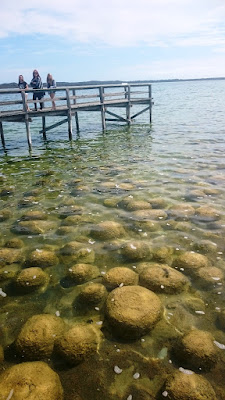
After a lovely weekend with Frank and Sue Egan in Rockingham, south of Perth, we reluctantly left the coastal areas for the inland. Frank and Sue had shown us the appealing seaside areas of Rockingham and Mandurah. Rockingham in particular has been beautifully landscaped and includes many lakes, both natural and artificial. Some, unfortunately, are surrounded by bush infested with tiger snakes. We also saw the Thrombolites at Lake Clifton (freshwater versions of the famed stromatolites, and just as exciting) and had a delicious lunch at Cape Bouvard Winery. We also checked out their new home in a lifestyle village at Pinjarra. It was great to catch up with them after such a long time. We wished we had more time to explore the southern parts of WA, but we have left enough places to see on another trip.
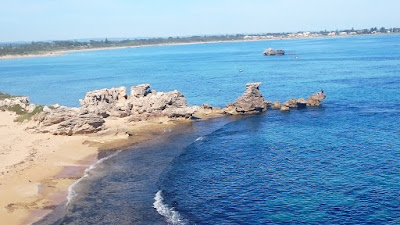
Rockingham and Mandurah from Point Peron
Thrombolites at Lake Clifton

Our destination was Wave Rock, located at Hyden, about 400km east of Perth. Contrary to my first imaginings it is nowhere near the ocean or any other type of wave. We had received mixed reports about it varying from "Why bother, it's just a rock" to "There are lots of things to see and do there". So it became a matter of go and see and make up your own mind.

Hyden is a small town of about 400 people in the middle of a major wheat growing area. It is heavily reliant on the tourist trade to bring money into the town and keep people employed. As it doesn't have a major supermarket it still has a butcher, which many much larger towns don't. It also has a very chatty librarian, who I suspect, doesn't have many people dropping by. The town has a historical display made of outdoor metal sculptures, and its garage gives caravan park patrons 4 cents a litre off fuel.

On the way we passed through Corrigan which has a dog cemetery, some graves shown below.
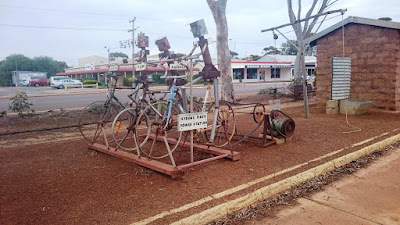


Above and below - sculptures in Hyden

Beautiful countryside at Hyden
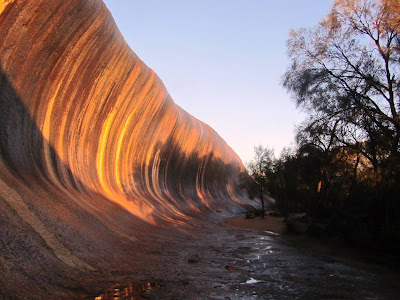
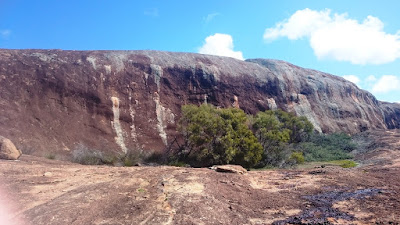
Wave Rock itself is part of Hyden Rock which has several minor features such as the formation known as Hippo Yawn,  the Breakers which are small rocks, and the Hyden water storage dam. According to the Guru,  the wave shape has been formed because the lower rock was wetter and eroded more quickly, creating an overhang at the top. When we first saw it late in the afternoon it looked rather dull, but David went for a walk early in the morning after it rained and it looked much more spectacular.
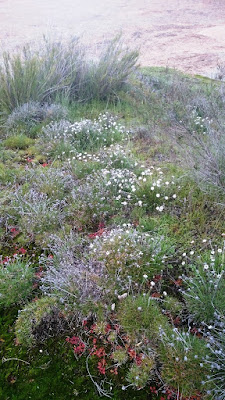

Plants growing on top of the rock
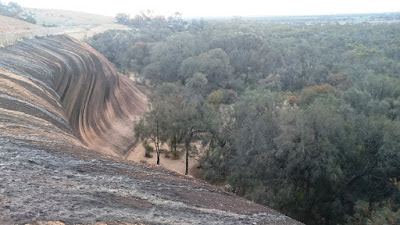
Looking down from the top. Notice the safety ledge

The morning light is much better, especially after rain

Hippo Yawn

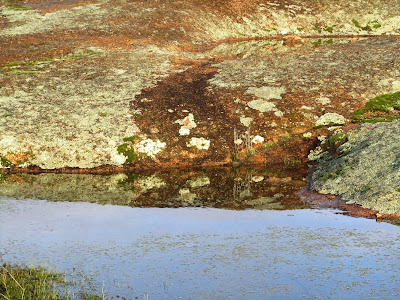
David took this photo of a reflection for me
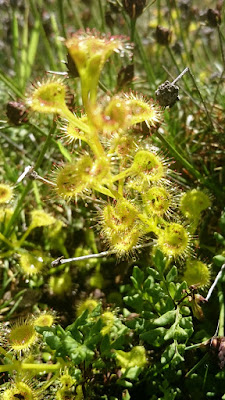
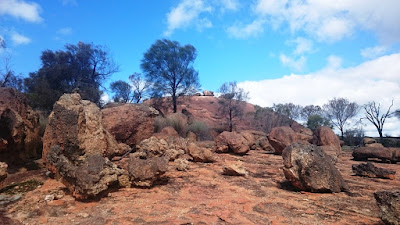
Much more interesting to me were the Humps, a rock formation about 18km away. Although it was quite steep in places I was more concerned about coming down a steep slope than climbing up. However it was definitely worth the climb. We probably saw it at its best as the rock crevices were full of water and the plant life was quite different with a lot of mosses and lichens (yes, I know they aren't really plants) and some tiny carnivorous plants, among many other species. The Guru felt the need to give me  a lesson on plant sucession,  but my camera diverted my attention elsewhere.
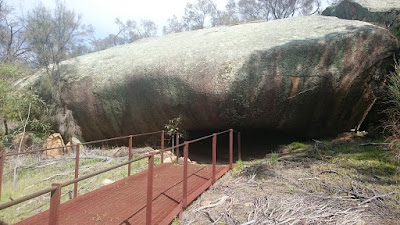
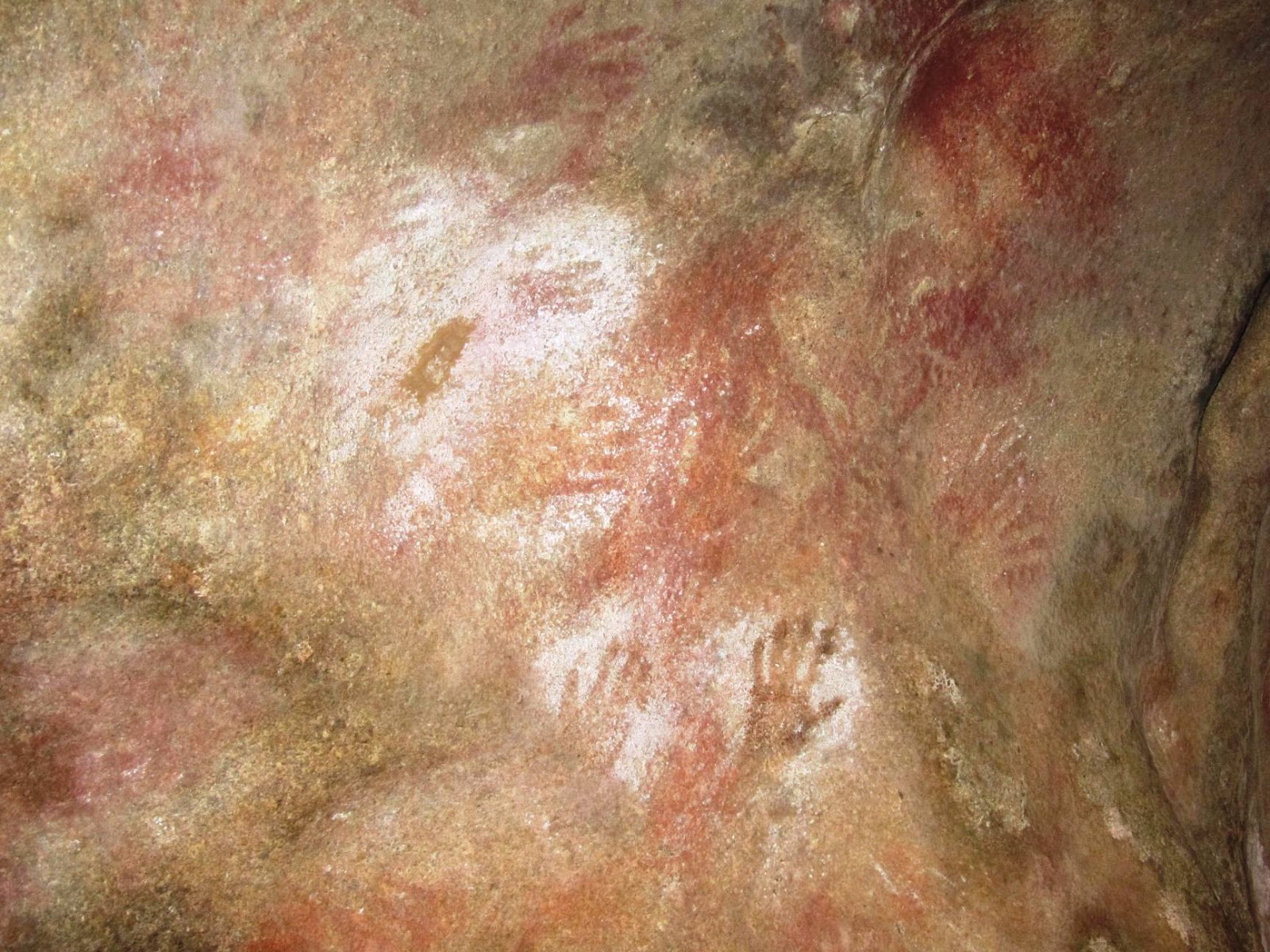
The Humps also contains Mulka's Cave, an Aboriginal rock art site with hundreds of hand stencils, but we could only see a handful as the floor of the cave was covered with large rocks.
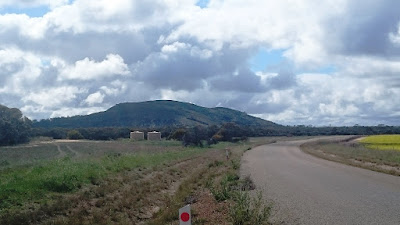
Approaching The Humps
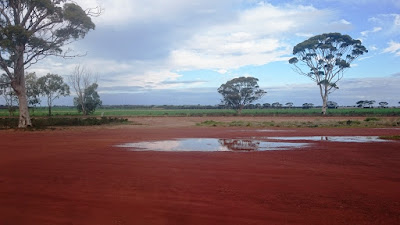
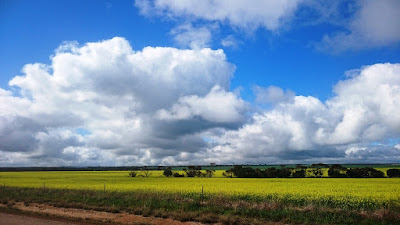
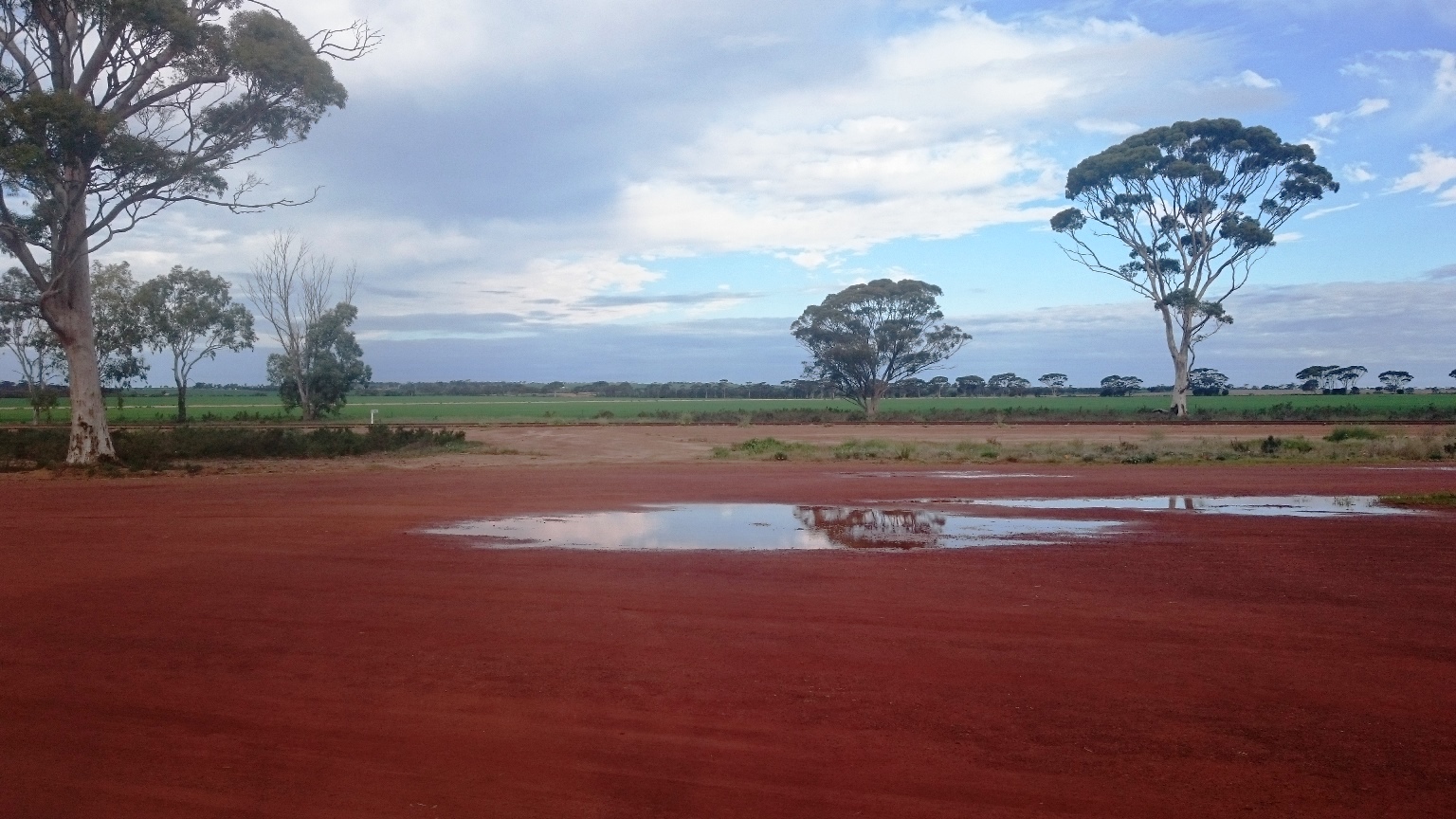
Canola crop and interesting weather
The entrance to Mulka's Cave
Hand stencils in the cave

Walking up the Humps, beautiful plant life
Tiny carnivorous plants

Another wave rock in the making
Towards the top. At the top it was too windy to hold a camera, felt like I could be blown off the edge
There are several other places to visit near Wave Rock including the Lace Place, Toy Soldiers display and a wildlife park to name a few. I found the Lace Place interesting,  with displays from the 1600s to the present, but David stayed at camp to find someone to chat to, and to gather some wood for the firepits generously placed around the caravan park. We had an excellent fire, the first for ages, mostly fuelled by mallee roots.

Our verdict was that Wave Rock and the surrounding area had enough of interest to see, and was definitely worth the visit.


Saturday, August 15, 2015

New Norcia 13 August

New Norcia is approximately 150 km inland from Jurien Bay and it is the only monastic town in Australia. It was founded in 1847, which is less than 20 years after Perth was settled. Two Benedictine monks fleeing religious persecution in Spain moved to England and then to Western Australia seeking a religious mission to work among the Aborigines.

With a generous land grant and a phenomenal capacity for work the monastery became self sustaining. Today there is a farm harvesting wheat, canola and lupins, as well as olives; a bakery which sells its produce through the gift shop, a hotel, a roadhouse, a caravan park, as well as an educational program of school camps. The abbey church is open to the public and people can pay to have baptisms or weddings performed there. 

The magnificence of these buildings which suddenly appeared in the countryside was quite a shock that the photos can't really convey

The monks' quarters and statue of St Benedict
The courtyard of the Monks' quarters
Despite all this there are now only 11 monks in residence, and much of the work is done by paid employees. The buildings are substantial, but most are not used for their original purposes. In the past the monastery ran an orphanage for aboriginal children, who were part of the stolen generation. Their parents lived locally but government policy had them removed from their families and handed over to the monastery. There were separate boys and girls aboriginal schools. As well there was a boarding school for non aboriginal boys and one for girls. The girls school was run by nuns and there was a convent on site as well.

St. Gertrude's Girls School
St. Ildephonsis Boys School
Above and below, the Aboriginal boys home and school


The schools have now closed down, but the buildings remain devoted to other uses. Still fulfilling their original purpose are the Abbey Church and the chapels in the boys and girls schools. They have been beautifully decorated by monks of an earlier period.
The Abbey Church
Inside the church an burial monument for the founder
Inside the chapel of the boys' school

Inside the chapel of the girls' school
We resisted the charms of the gift shop and missed out on the last loaf of bread. It is very obvious that the gift shop is another part of their successful business enterprises. It was a very interesting place to visit and the oranised tour was well worth doing. The tour guide was very impressive. We didn't have time to explore the museum, which I'm sure would have been very interesting.

To return to our main focus of seeing the natural environment at its best, today's delight was the abundance of Ringneck parrots which were using the roadside as their personal restaurant, and were hardly bothered by passing traffic. But speaking of traffic, we have been on the Great Northern Highway today and I think we have seen nearly as many trucks today as we have in all the rest of the trip combined. Staying at Bindoon it was trucks all night. It's a bit of a shock.