Saturday, August 15, 2015

Jurien Bay and the Pinnacles 10-12 August

Jurien Bay is approximately halfway between Geraldton and Perth and is another small seaside town of about 2000 people. We followed the coastline from Dongara, about 100km south of Geraldton to Jurien Bay, past heavily vegetated sand dunes and seaside shacks. We didn't see the lovely coastline at its best as it rained intermittently most of the way. However, a couple of days later the sun shone and it was worth having a better look.

Mural at Jurien Bay Jetty
The Jetty foreshore
Green Head, further north
Camp site at Sandy Cape, behind the beach. North of Jurien Bay
Our first stop in this part of the coast was to visit some more stromatolites at Lake Thetis, near Cervantes, 24 km from Jurien Bay. We were a bit underwhelmed by the first lot we saw near Shark Bay, so we thought these might be better. They were different but not necessarily better. We have since found out that they are microbial structures that are estimated to be 3370 years old so we should be more impressed.

Stromatolites at Lake Thetis
One up close
Next stop after a coffee break was the Lobster Shack for a tour of the factory which processes the western rock lobster, commonly known as crayfish, for sale. Most of the catch is exported. The lobsters are humanely stunned in icy cold water, graded for size, purged for 3 days and then packed among sawdust in polystyrene containers to be transported in temperature controlled environments. The tour was followed by the obligatory lobster lunch, not included in the tour price of course.

Inside the Lobster Factory. Each crate is full of lobsters
A size H lobster, their biggest size for grading
More interesting toilet doors. The factory is very popular with Asian tourists
Our lobster snack. Too many chips though
Nambung National Park, home to the Pinnacles is nearby. They are stone-like structures of varying sizes and shapes, some well over 3 metres tall. They are located among sand dunes, and there are thousands of them, far too many to take them all in at a glance. You can walk among them easily, and a 4km long road winds among them. They are quite amazing to see and more impressive than we expected. Scientists haven't come to an agreement as to how they were formed, but they are made of accretions of limestone.
All the little specks are pinnacles
A closer view of a small section of them
Pinnacle Hugger
Wind erosion makes strange shapes


On Wednesday we decided to visit Lesueur National Park which is north east of Jurien Bay, but not far inland. I had heard reports that it was very attractive but wasn't prepared for the diversity of wildflowers and the denseness of the vegetation. There were grass trees everywhere among the heath. Further on there were quite large trees as well. It has been unusual to find large trees in WA. In most places it is too dry for them. I took lots of photos, but won't bore you with too many.


Oops, that was probably too many!

Next we visited Stockyard Gully National Park, which has a large cave that was previously used by drovers to secure their stock at night. Unfortunately there had been too much rain for us to access the cave, so we went for a walk along the creek, turning back at the sign that said there was a risk of bee sting if we proceeded further. It was a lovely walk along the creek with interesting rocks and some quite mature trees. I think David enjoyed the drive in and out with mostly sand interspersed with a few rocks and lots of potholes to make it interesting.

It was a pleasant walk along the creek
These weirdly shaped rocks were abuzz with bees
David excelled himself again today in finding lizards on the road. He found 2 stumpy tailed lizards, or shingle back lizards, in different parks, to add to the 2 thorny devils has has found previously. In these cases tunnel vision has been useful. Now, every time he stops the car suddenly, I think he's found another lizard.

As the weather improved while we were at Jurien Bay I was finally able to get a decent sunset photo, the first for ages. It was a nice finish to our time there as there will be few opportunities for Indian Ocean sunsets from here on.

Sunset at Jurien Bay

Tuesday, August 11, 2015

On the wildflower trail 8-9 August

On leaving Geraldton we headed east towards Mullewa, one of the many places with outstanding displays of wildflowers. After lunch in Mullewa we headed south to stay at Coalseam Conservation Park, one of many administered by Parks and Wildlife, but overseen by volunteer Camp Hosts. 
Despite the pleasant surroundings it was raining and cold, one of the coldest days we have experienced since leaving Alice Springs in mid May. In fact I piteously complained to David, "I want to go back where it's warm."

Next morning the sun shone brightly and off we went to search for wildflowers. No, I didn't have to twist David's arm, he is very impressed with the colour and variety on show. The particular quest was to find the elusive wreath flower which I hadn't heard of until recently. They prefer to grow in low quality disturbed soil, particularly along roadside verges. With explicit directions we found them,  but the cars pulled up along the road in the middle of nowhere were a bit of a giveaway.


The line of green "pancakes" along the edge of the road are all wreath flowers at various stages

After the wreath flowers we found several other types, such as Smelly Socks and Pink Poker, and varieties of pink, yellow and white everlasting daisies. They make beautiful spreads through the bushland that the camera can't really capture.


The other event of the day was a traffic jam! About 6 cars and a couple of vans were stopped on one side of the river as a large dual axle caravan had changed his mind about doing the water crossing, reversed to go back and promptly got bogged, holding up everyone, including a number of cars from a Variety Bash. However, while maxtrax were deployed on one side of the river, our side had a bit of fun. One of the Variety cars was decorated for the Beach Boys,  the Avan driver ahead of us found his Beach Boys music and his wife danced on the road with the Variety guy in full beach rig. We met up with the cars again near the wildflowers and they were having a fine time with loud car horns, firecracker noises and plenty of liquid refreshment. We hope they had their designated driver strategy firmly in place.
A well-named Avan


Half the traffic jam
The Beach Boys vehicle
A faded Beach Boy, with the bogged van in the background
Captain Underpants
The Variety Club Bash vehicles at Pindar
After a lovely sunny day, we finished with a campfire put on by the camp hosts, then a very cool night with extra blankets needed.

Monday, August 10, 2015

Geraldton 6-7 August

We only spent one whole day in Geraldton so we didn't sample many of its delights. It did have a few surprises though. We had no idea of its population before we arrived and had made a guesstimate of between 5000 and 10000. How wrong we were! It is probably closer to 40 000, and actually has suburbs. It is a combination of a port city where crayfish, or lobsters, are a big industry, and a rural service centre selling tractors and other farm equipment. The surrounding countryside is mainly pastures such as wheat. It is unusual for us to see wheat grown within sight of the ocean.


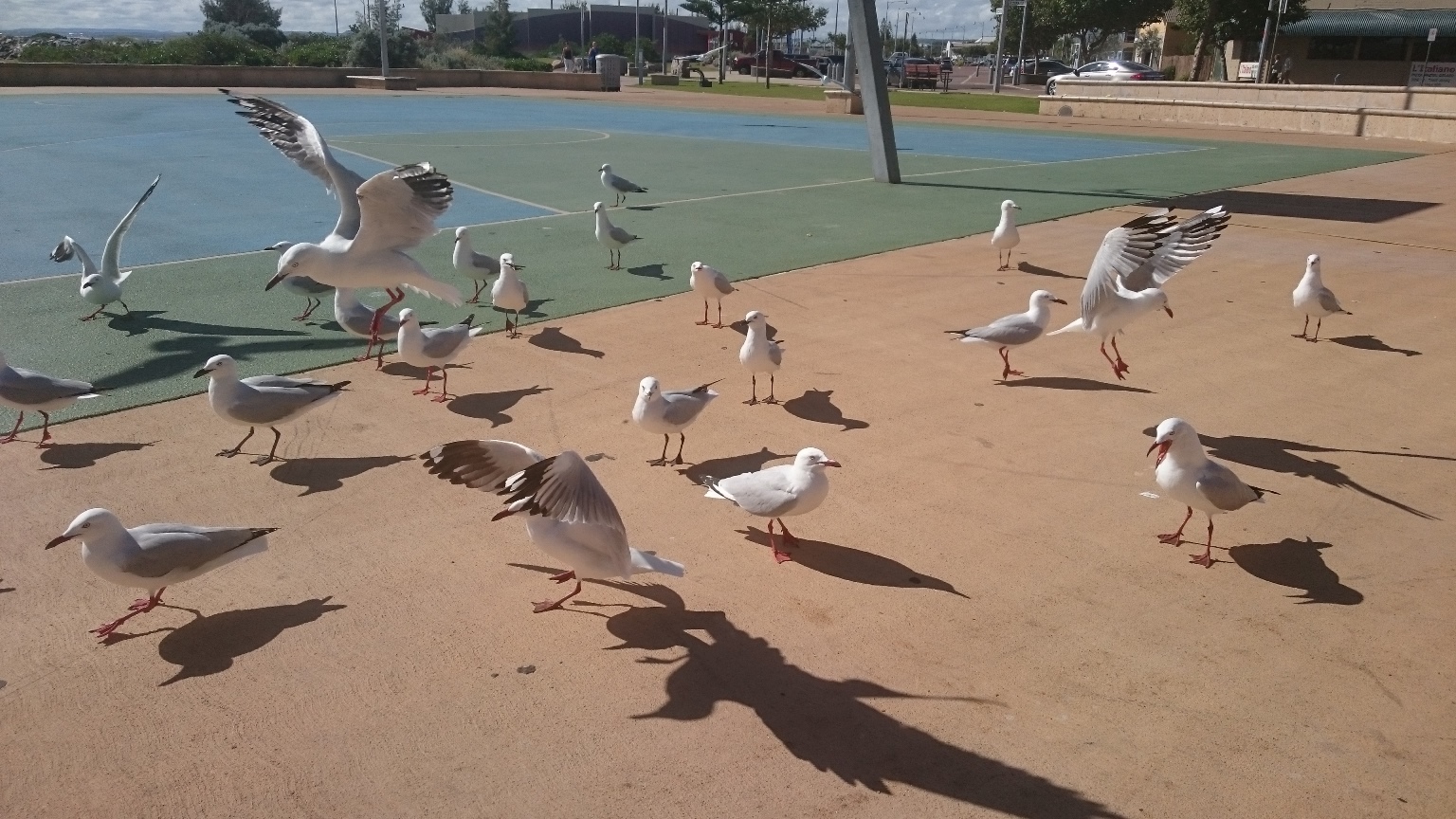
Fish and chips at the waterfront with the waiting flock of seagulls anticipating scraps

Geraldton has many museums and a proud history but the memorial to HMAS Sydney II is a dominant feature. We took a guided tour which was very informative as it explained all the symbolism embedded in its structure. The Sydney was sunk on 19 November 1941, with a total loss of all 645 men on board. The wreck of the Sydney has only been located within the last 10 years.
The memorial is located in Geraldton because that was where many of the men spent their last shore leave before departing. It has several components: a circular dome composed of 645 seagulls. Sailors believe that seagulls represent the souls of lost seamen. There is a stele, which represents the prow of the ship and a bronze statue of a waiting woman, symbolising those who waited in vain for the ship's return. A black granite memorial wall lists all of the seamen who were on board. A final component was added after the ship was found. It shows the West Australian coastline and marks the spot where the wreck lies.
The dome with 645 seagulls
The stele and the waiting woman
The final piece of the memorial indicating the position of the wreck
The bronze of the waiting woman and the tour guide
The volunteer guide who presented all the information did an excellent job of interpreting this very moving memorial. He said there is often someone in the tour group with a personal association with the ship and on our tour this was also the case. The uncle of one of our group went down with the ship.

After lunch of fish and chips on the rejuvenated waterfront we decided to visit the abandoned village of Greenough, now owned and restored by the National Trust. Until about the 1930s it was an active village, but it's location on flood prone land led to the occupants relocating. All the buildings that remain are built of stone and have been well restored. The two churches are still in active use, and the village store has been converted into a coffee shop and gift shop. Quite incongruously there is a small herd of llamas or alpacas grazing in the village.
The Catholic Church and presbytery

David studying exam questions
The requisites for setting up a school in 1870
The schoolhouse
Holding forth in court
The police station and courthouse
Intoning from the pulpit in the Anglican Church
The interior of the Catholic Church
Alpacas in the village
The surrounding countryside is all still lush green farmland. I don't know whether it is usually so green, as there has been quite a lot of rain recently. There are many stone buildings of the period scattered throughout the district, some still in use and others decaying. One of the surprising features of the area is "the leaning trees of Greenough". As the area is so windy it burns off growth on the southern windward side causing the trere hees to lean and grow horizontally. It seems to affect only a particular species of West Australian river gum. I don't like to claim they are unique but they certainly are very unusual. 

The Leaning Trees of Greenough